AI Maker Matrix: A Framework for AI Product Segmentation


Last time, I kicked off this series on my takeaways from Reforge's AI Strategy course by exploring how AI accelerates PMF collapse. This week, I'm going deeper: who exactly are you building for, and why does getting that wrong doom so many AI products?
The framework I'm sharing—Reforge's AI Maker Matrix—has already changed how my teams at Ontra talk about our users and build AI products. Hopefully it proves just as useful for yours.
Why AI User Segmentation Matters
A critical consideration for any product is who you're building it for. AI products are no different, but they do require special considerations to resonate with target user groups. What may be an extremely helpful feature for one user could annoy another.
Likewise, building a generic AI product is unlikely to find strong fit with any single persona. The most common failure mode I've seen in early AI products is building for everyone within a market. Ontra's products focus on lawyers as primary users, and within that persona there are vastly different needs among sub-personas—a junior associate's needs differ sharply from a senior associate's. If you try to build for both, you usually fail both.
Other common mistakes include:
- Misaligned needs: Assuming users want automation when they actually want assistance or education.
- Over-promising: Selling full automation of a task when the tech isn't quite there yet.
One way to address these pitfalls is to better segment users and the ways they interact with generative AI. Reforge calls this the AI Maker Matrix, and I've found it incredibly impactful in my day-to-day work.
Taste vs. Craft
Before diving into the personas that make up the Maker Matrix, it's important to understand the two dimensions it's built on: Taste and Craft.
Taste (The "Eye"): A user's ability to judge quality. Someone with high taste can instantly assess whether an output works—be it a piece of code, a legal argument, or a design. They have clear opinions and domain expertise.
Craft (The "Hand"): The technical ability to execute. A senior software engineer has high craft in coding; a principal designer has high craft in visual creation; a senior lawyer has high craft in negotiating legal documents. They know how to make things happen.
When mapping users on these two dimensions, we get four distinct user segments. Each requires a radically different product strategy, business model, and go-to-market approach.
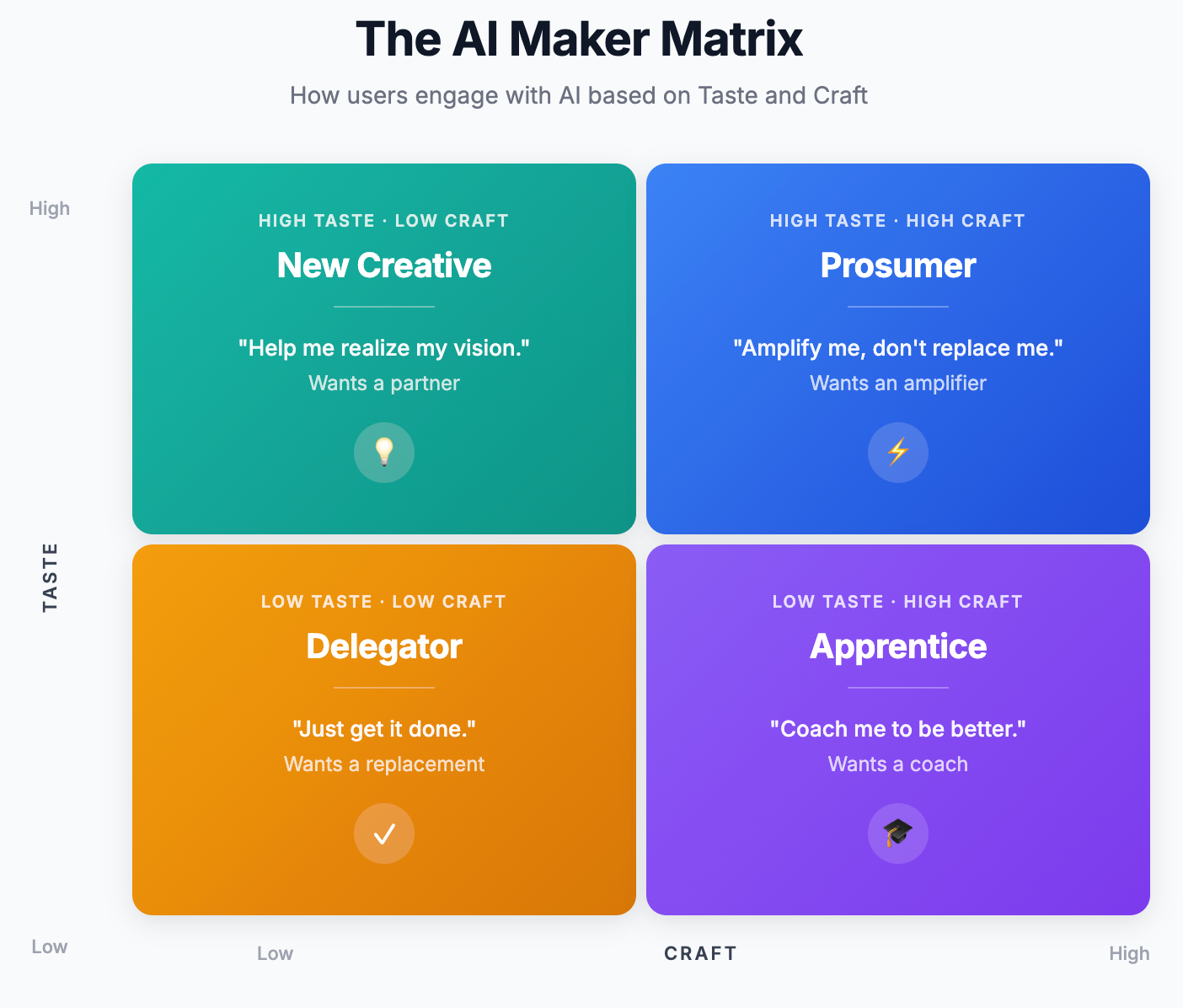
1. The Prosumer (High Taste, High Craft)
The Mindset: "Amplify me, don't replace me."
Prosumers are your most sophisticated users. They have deep domain expertise and the skills to execute, but they want to work faster. They are skeptical of AI claiming to do their job better than they can.
Example
Cursor: Professional developers don't want an AI to write the whole app for them; they want an IDE that offers real-time suggestions and autocomplete to speed up their workflow. Cursor markets itself as a tool to make you extraordinarily productive, unlike Devin, which markets itself as an "AI teammate" that does the work for you. Cursor has found stronger product-market fit than Devin to date.
How to Build for Them
- Augmentation over automation: Focus on eliminating repetitive tasks while preserving high-value decision points where these users can leverage their combination of high taste and high craft.
- Deep integration: Fit seamlessly into their existing workflow (e.g., Cursor forking VS Code so it feels familiar).
- Fine-grained control: Give them customization parameters. They want to steer the ship, not be a passenger.
- Professional-grade output: They have high taste; they will not tolerate hallucinations or average quality.
Go-to-Market & Business Model
- Strategy: PLG works best here. They want to test the tool against their specific workflow before buying. They trust hands-on experience over marketing claims.
- Pricing: Seat-based. They want unfettered access and shouldn't worry about usage limits.
- Risk: Low platform risk. Horizontal platforms (like ChatGPT) are unlikely to solve for the deep, power-user workflow needs of specific verticals.
2. The Delegator (Low Taste, Low Craft)
The Mindset: "Just get it done."
Delegators exist on the opposite end of the taste/craft spectrum from Prosumers. They view the job to be done as a commodity or a chore. They don't care about the process; they care about the outcome. Essentially, they are hiring the AI as a contractor to get something fully off their plate.
Example
Synthesia: A small business owner needs a training video. They don't want to learn video production (Craft) and they aren't looking for cinematic perfection (Taste). They just want a professional-looking video generated from text.
How to Build for Them
- Simplify inputs: Use structured forms and wizards. Minimize decision points.
- Emphasize outcomes: Sell the result (the video, the document), not the creative tool.
- Templates are essential: These users need pre-built starting points to ensure reliability.
- Quality guardrails: Because they lack Taste, your system must automatically detect and prevent low-quality outputs.
Go-to-Market & Business Model
- Strategy: Sales-led or consultative. These users often need guided onboarding, integration support, and clear ROI justification. PLG often fails here because setup can be too complex.
- Pricing: Outcome-based (pay per video, per document). Volume discounts work well.
- Risk: High platform risk. Because Delegators care about outcomes rather than workflows, they will switch instantly if a major platform (like Google or Microsoft) offers a "good enough" version of your solution. You must build deep domain expertise (like Synthesia's focus on corporate training) to defend against this.
3. The New Creative (High Taste, Low Craft)
The Mindset: "Help me realize my vision."
These users have excellent judgment (Taste) but lack the technical skills (Craft) to execute. Think of a music lover who hears a song in their head but can't play guitar, or someone who loves visual art but doesn't know Photoshop. AI bridges the gap between their imagination and execution.
Example
Midjourney & Suno: Users describe the mood, style, and vibe (Taste), and the AI handles the rendering and composition (Craft).
How to Build for Them
- Vision-first interfaces: Prioritize natural language and visual references over technical knobs and dials. These users need help executing on their vision and don't know how to get there—your product needs to bridge that gap.
- Iterative refinement: Allow users to guide the AI closer to their vision through feedback loops ("Make it moodier," "Change the lighting").
- Taste transfer: Let them reference existing works they admire as shorthand for their aesthetic preferences.
Go-to-Market & Business Model
- Strategy: Community-led growth. Midjourney's decision to launch via Discord was brilliant—it created a space where users could learn prompts from each other and get inspired.
- Pricing: Creation-based / Tiered. Free tiers to hook them with an "Aha!" moment, paid tiers for higher quality and commercial rights.
- Risk: Moderate to High. Big platforms (OpenAI, Anthropic) see creative tools as the best showcase for their models. Your defense is building a strong community and network effects that are hard to replicate.
4. The Apprentice (Low Taste, High Craft)
The Mindset: "Coach me to be better."
This is often the smallest but most overlooked segment. These users have technical skills but lack nuance or judgment. Think of a developer who writes clean code but struggles with UX, or a lawyer who can negotiate but struggles to understand the nuance of certain provisions. They want validation and improvement.
Example
Grammarly: It doesn't just fix errors; it explains why a sentence is unclear or the tone is off. It acts as a coach, helping the user develop their own judgment over time. This approach built a multi-billion-dollar company.
How to Build for Them
- Actionable feedback: Don't just flag errors; explain the reasoning.
- Learning moments: Integrate "teaching" directly into the workflow.
- Before/after comparisons: Show them specifically how the suggestion improves the output to build trust. This allows them to leverage their high craft while developing their taste.
Go-to-Market & Business Model
- Strategy: PLG (Freemium). Start with a free utility (e.g., a grammar checker) to prove value, then upsell the "coaching" capabilities.
- Pricing: Subscription-based. They are paying for ongoing development and access to the "coach."
- Risk: Moderate. Platforms will add basic feedback features, but deep, domain-specific coaching (like legal writing or security code reviews) remains a defensible niche.
One User, Many Personas
Here's what makes this framework especially useful: personas aren't fixed identities—they shift by task.
Take Ontra. Document upload is a necessary step in our product, but no lawyer wants to apply craft or taste to it. For that task, even senior attorneys behave like Delegators. But when it comes to negotiating contract language, the same senior attorney becomes a Prosumer, a junior associate is an Apprentice, and an admin might still be a Delegator.
This means a single AI tool may need to serve users differently depending on what they're doing. The key is to nail the experience for one segment before expanding. Scope your features by quadrant, decide which segment is most critical to win first, and build outward from there.
Bring This to Your Teams
I recently ran a workshop using this framework at an offsite with Ontra's Flagship Product Leads. If you're looking to create shared language around AI user needs, I'd encourage you to do the same.
How to run the exercise:
- Plot your user personas on the matrix.
- Plot your key features on the matrix.
- Compare: Do they align? If a feature targets Prosumers but your primary users are Apprentices, you've found a gap worth discussing.
Anchoring the conversation to a real feature makes it concrete. Abstract frameworks only stick when they're grounded in your product.
Bringing It Home
Building a successful AI product isn't just about the technology; it's about understanding the relationship between the user and the machine.
- Prosumers want an amplifier.
- Delegators want a replacement.
- New Creatives want a partner.
- Apprentices want a coach.
Identify which quadrant your user lives in, and you can stop building for "everyone" and start building something that actually sticks.


