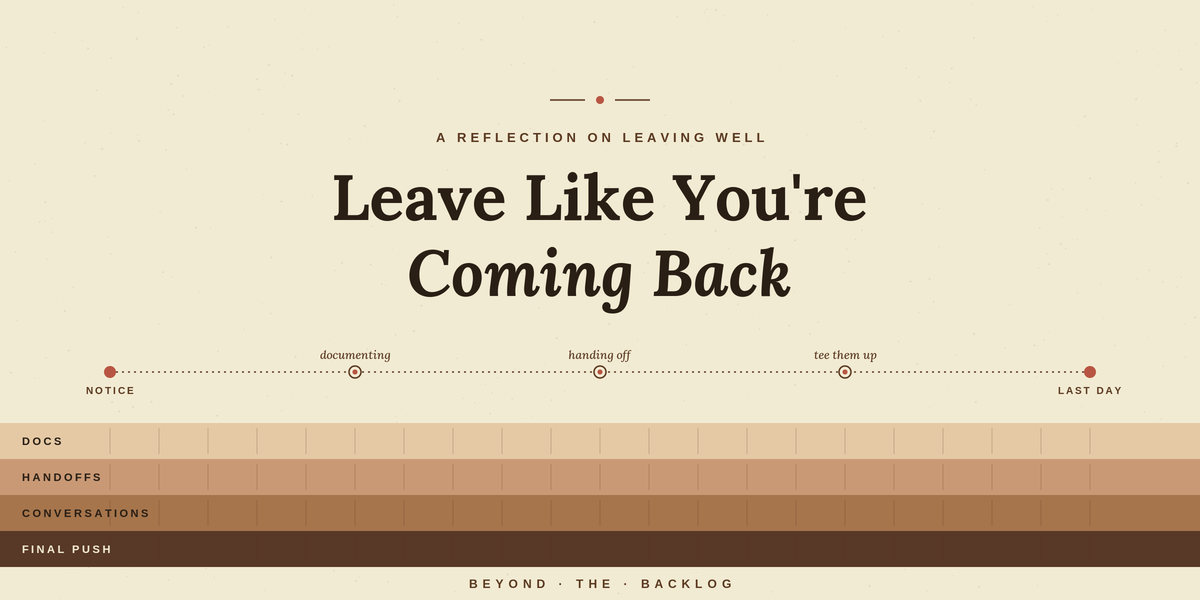
Leave Like You're Coming Back

Last week I wrote about what 4.5 years at Ontra taught me. This is the companion piece, about deciding to leave and how to leave well once you do.
The decision to leave was one I went back and forth on a lot. I had seen Ontra through much change, built incredible relationships, and felt a high sense of ownership over the direction of the product, but new and exciting opportunities were coming my way. I ultimately did decide to make the jump, but what made that decision the hardest was knowing that I'd be leaving behind an amazing team – I can't say enough how much I enjoyed working with my colleagues at Ontra!
Once I decided to leave, the job became about something different: making sure that my teams and colleagues were set up for success to carry the baton forward.
Deciding to leave is hard. Leaving well is harder. One is for you. The other is for everyone else.
My last day was this past Friday. Navigating the transition period out of Ontra gave me a few lessons to share about how to leave well when you're destined for a new job.
The work isn't done. Don't act like it is.
The most tempting thing to do once you've given notice is to coast. You're already gone in your head. The deadlines feel like someone else's problem. The meetings feel like a formality. Why pour energy into something you're walking away from?
Because the version of yourself who showed up for years is the version of yourself you want to be in the room when you walk out. The way you behave in your last two weeks is the way people will remember you for years. Coasting is corrosive — both to your reputation and, more importantly, to the people who are still going to be there after you leave.
The knowledge in your head is a debt.
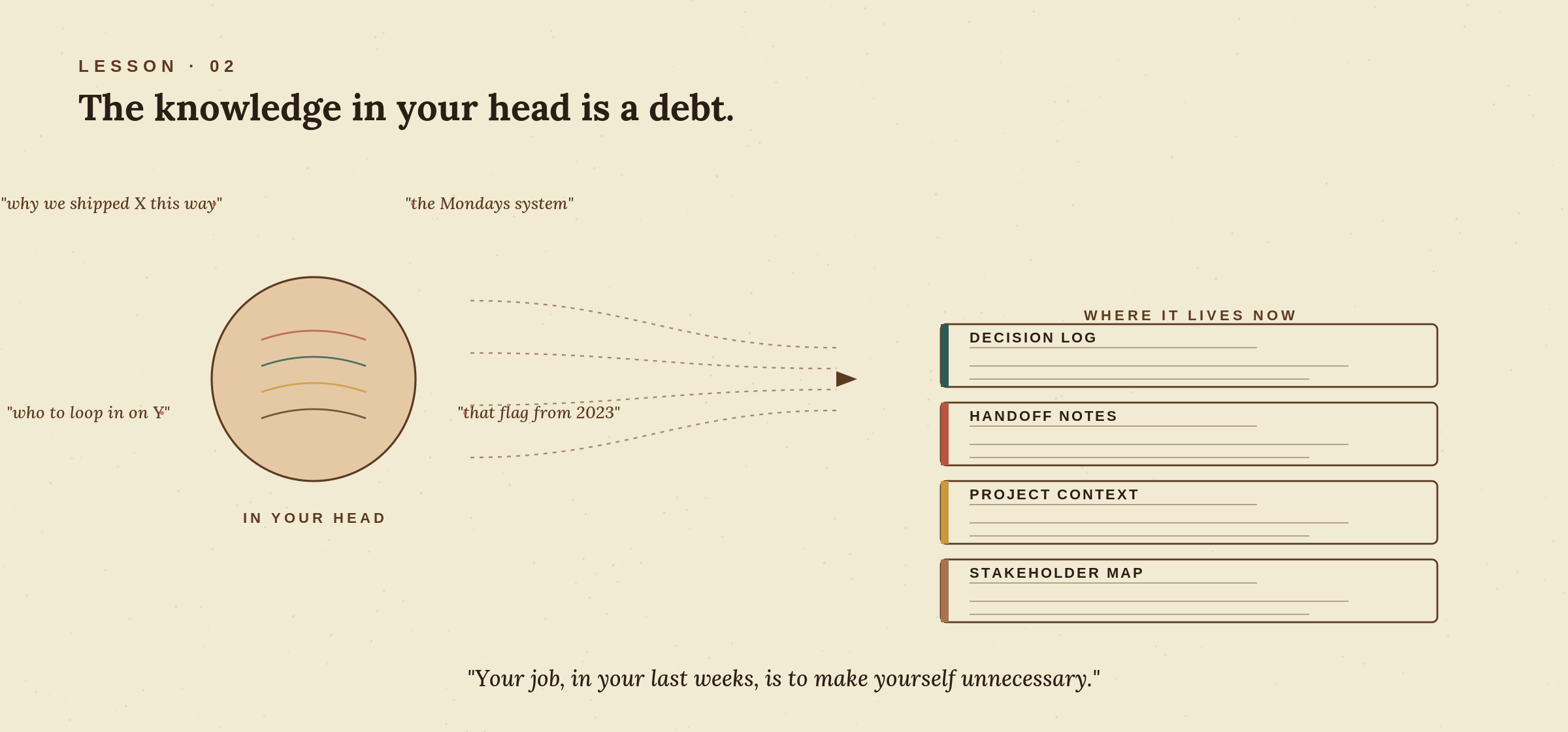
The longer you've been somewhere, the more institutional knowledge you've quietly accumulated. The reason a particular flag exists. The history behind a weird workflow. The customer who needs to be looped in before any change to a specific feature. The internal politics around the system nobody touches on Mondays.
Most of this isn't written down. It's in your head. And the moment you walk out the door, it walks out with you — unless you do the unglamorous work of putting it somewhere your team can find it.
I've spent the last few weeks writing docs I never had to write before. Decision logs. Context for half-finished projects. Notes on stakeholders. Why we made the calls we made. The point isn't to leave a perfect knowledge base. The point is to leave fewer "I wonder why he did that" moments behind.
Your job, in your last weeks, is to make yourself unnecessary.
Your team's first month without you is your last contribution.
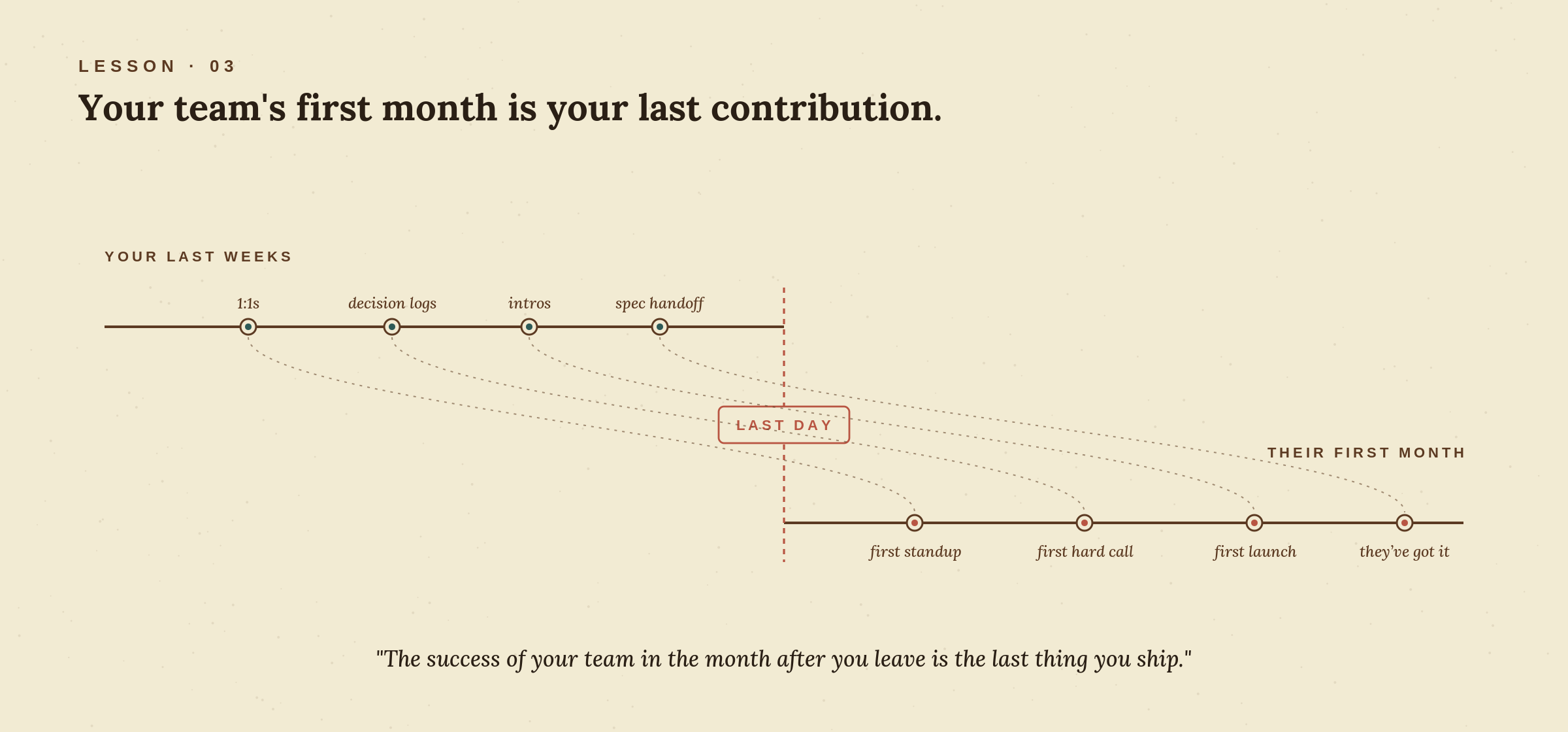
If you manage people, this is the most important work of your departure.
Your team is going to be navigating uncertainty the day after you leave. Who do they escalate to? Which projects need a new owner? Which stakeholders need a warm handoff? Which conversations were you in the middle of? Which battles were you fighting on their behalf that nobody else even knows about?
Spend your last few weeks making sure the answers to all of those exist somewhere other than your head. Have one-on-ones that are explicitly about the transition. Tell your team what you've appreciated about each of them, in writing. Make introductions on their behalf to people who can help them after you're gone. If you have political capital you can spend on their behalf, spend it now — you won't be able to later.
The success of your team in the month after you leave is the last thing you ship.
Have the hard conversations early, not late.
There are conversations you've been putting off. Feedback you've been meaning to give. Expectations you've been meaning to reset. Relationships you've been meaning to repair. The instinct, on your way out, is to skip them. They feel awkward when you're leaving. They feel like sour grapes.
They're not. They're a gift, if you give them with care.
The people who will benefit most are the ones still going to be there. The new manager who needs to know what they're walking into. The peer who needs honest feedback you owed them six months ago. The teammate who needs to hear what you actually thought of their work — the good parts, especially.
Don't unload. Don't moralize. But don't leave conversations undone that someone is going to have to have anyway, after you're gone, without the context only you had.
Don't trash the place. Especially if you have reasons.
Most of the time, when someone leaves a job, there's a story they could tell — about leadership, about politics, about something that broke. Sometimes those stories are accurate. Sometimes the temptation to tell them, on the way out, is enormous.
Don't.
Not because the stories aren't true. Not because you owe the place silence. But because how you talk about a place you're leaving says more about you than it does about the place. Future colleagues, future bosses, future hires are listening for whether you can hold a complicated relationship without flattening it into a grievance. The way you exit is a signal about how you'd eventually exit them.
You can be honest about why you left without being a flamethrower about it. "It wasn't the right fit for me anymore" is a complete sentence. "I'm ready for a different kind of challenge" is a complete sentence. The full breakdown of every grievance is yours to keep.
Leave the place at least as good as it was when you walked in. If you can't, leave it quietly.
Leave like you're coming back.
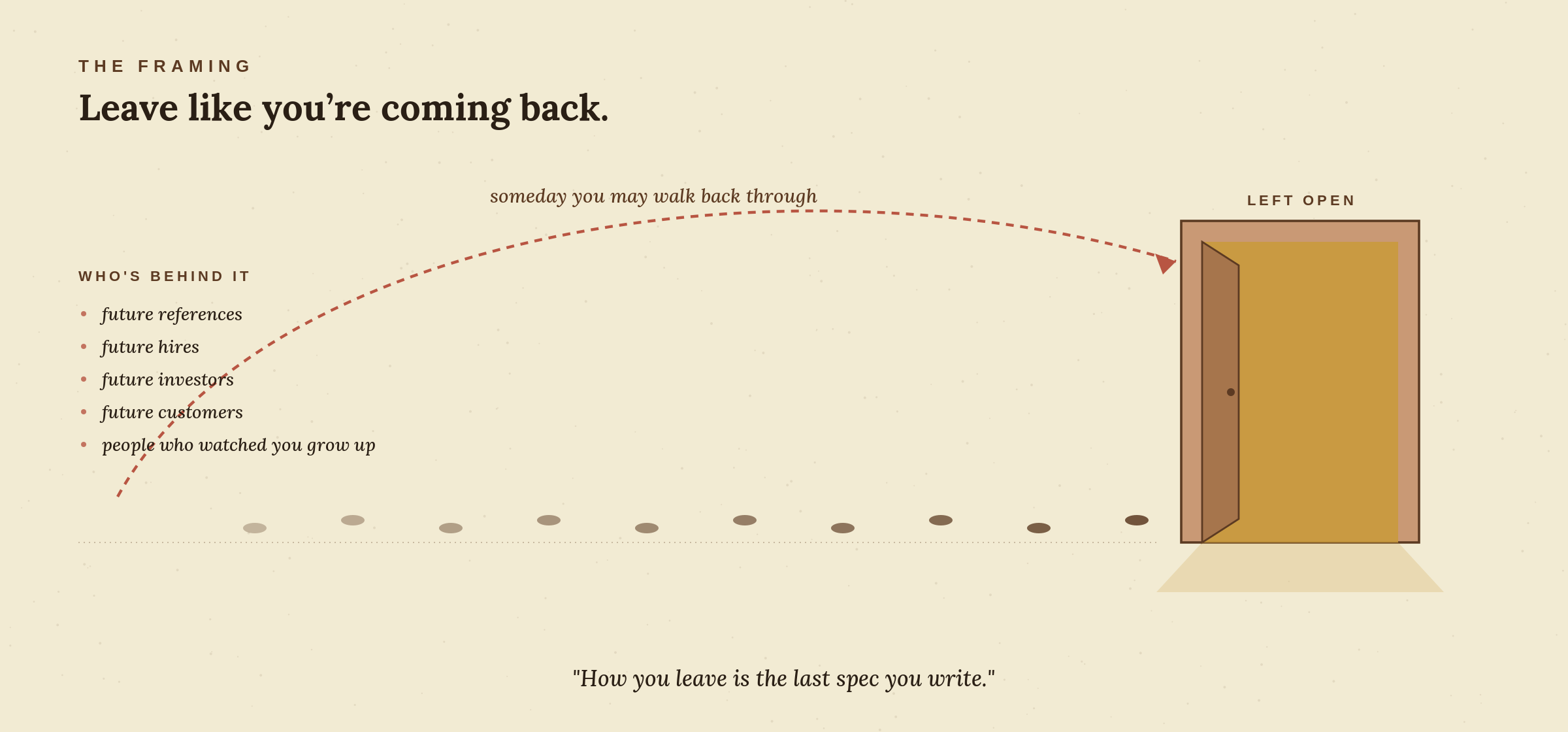
The framing I keep coming back to is exactly that.
You probably won't come back to the same job. But you're going to run into these people again. They're going to be your future references, your future hires, your future investors, your future customers. The industry is smaller than it looks. The way you leave the door open behind you matters more than almost anything you do in the first few months at the next place.
But it's bigger than the network logic. The truth is that how you leave is part of the work. It's the last spec you write. The last decision you make. The last evidence of what kind of person the company hired in the first place.
You don't get to claim you cared about the people, the work, and the mission for years and then check out the moment you've decided to go. The caring has to extend through the goodbye, or it wasn't quite what you said it was.