The Lessons That Only Show Up If You Stay

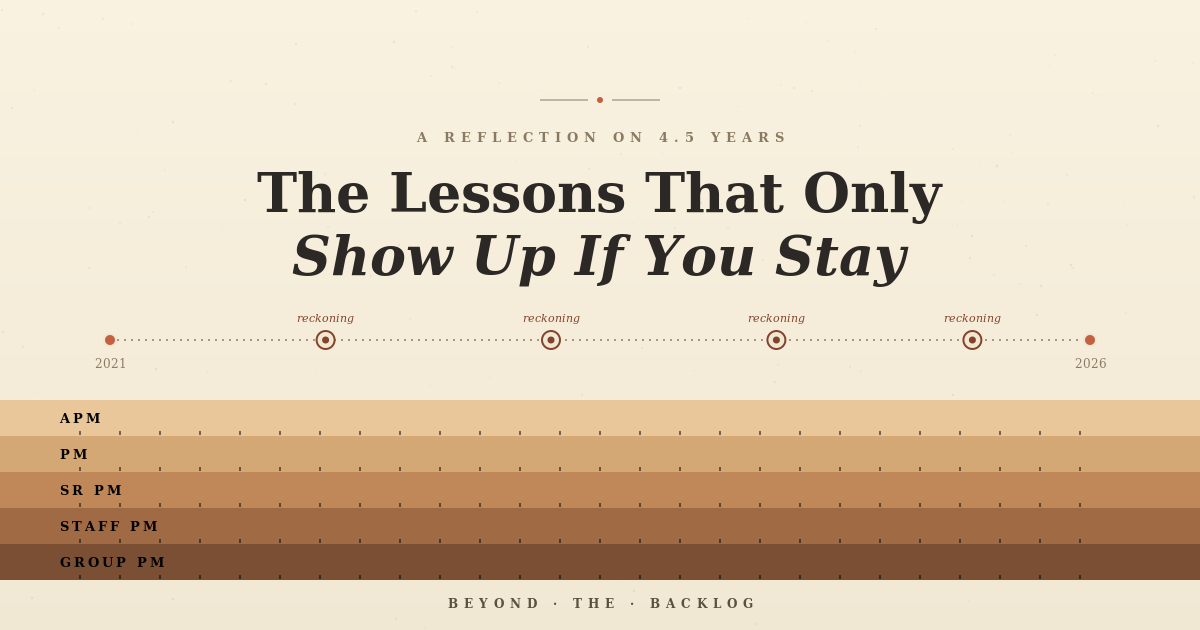
Four and a half years ago, I joined a Series B startup called Ontra as an associate product manager. My last day is this Friday. Over the last 4 years and change, I've learned a lot and seen a company change from scrappy startup into a scaled legal tech company.
While at Ontra, I've learned something that job-hopping advice on LinkedIn could never convey – there is a category of lessons you can only learn by staying somewhere long enough to be five different versions of yourself in the same organization. In that span I went from APM, to PM, to senior PM, to staff PM, and ultimately to a Group PM leading four product teams. The job changed under me about every nine months. The company changed faster than that.
Staying through that change wasn't a passive choice. I worked under four different product leaders in those 4.5 years. Every time one of them left, it forced a reckoning. Was the bet on Ontra still the right one? Was this still the right place for me to grow my career? Each time I had to decide all over again and adapt to new people, new strategy, new everything.
Staying isn't one decision. It's the same decision made over and over, every time the ground shifts under you. That's the part that's hard at the beginning, and it doesn't really get easier — you just get better at sitting with the discomfort and asking the question honestly.
Here are some of the lessons I gleaned through my time at Ontra.
1. The weird side-quest becomes your foundation.
When you start in a startup as a PM, you've got to look for the problems that need solving and take them on as your own. In my first year, I worked on our machine learning taxonomies alongside our ML team and other subject matter experts. At the time, this was not the most glamorous project – it was a long slog of updating individual line items on a Google Sheet.
Three years after starting that Google Sheet, it had become the connective tissue underneath our ML predictions, our Digital Playbooks, and our AI summarization product. Along with that, I became the go-to person for a whole array of AI functionality.
The lesson: you cannot always predict which thing compounds. You can only show up, do the work, follow your passion, and advocate for the things you believe will be impactful.
Side note: it's equally important to let go of your babies. With the LLM revolution, the taxonomy became a lot less critical to our tech stack and it was time to pivot toward a more modern infrastructure. If you love it, you've got to let it go.
2. The single highest-leverage skill is making people feel safe to disagree with you.
I've written about psychological safety, but its importance cannot be overstated. Cultivating an environment where a team feels safe pushing back, where dissent doesn't feel risky, and where the loudest opinion doesn't win by default gives you a team that will produce ideas you never considered.
I didn't fully understand at first how rare those environments are or how much of my actual leverage came from making one. The product decisions we made weren't usually wrong because we missed key data or didn't understand what a decision would lead to. They were wrong when nobody felt comfortable telling the most senior person in the room that they were missing something that needed accounting for.
If you only optimize one thing in how you run a team, optimize for psychological safety. Everything else is downstream.
3. PMs don't have authority. They have relationships.
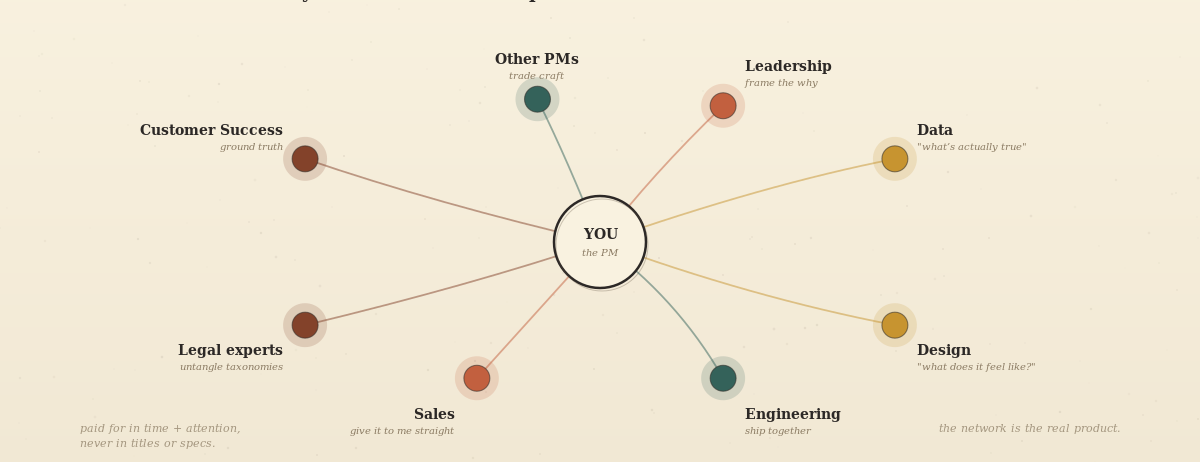
This is the lesson I wish someone had hammered into me on day one. Your title doesn't give you anything. Your roadmap doesn't give you anything. Your spec doesn't give you anything. The only thing that actually moves work forward is the trust you've built with the people you need to help you accomplish goals.
I spent 4.5 years at Ontra investing in relationships — not as a strategy, but because I genuinely liked the people. The benefit turned out to be enormous. When I needed engineering to take on something risky, they'd hear me out because we'd shipped together before. When I needed a sales partner to give me an unvarnished read on a feature, they'd give it to me because I'd shown up for them at a prospect pitch. When I needed legal experts to spend hours of their time helping me untangle a taxonomy, they'd say yes because I'd had their back and they knew me.
Compound that across hundreds of Slack threads and dozens of offsites with night caps — at some point you realize that what you actually have, as a PM, is a network of people who will pick up the phone when you call.
That network is your real product. Everything else is just artifacts.
You can't fake it, either. Relationships are paid for in time, attention, and the moments where you choose to be helpful when you didn't have to be. You can't rush it. You can only keep showing up and making the small choices to invest in people that pay dividends down the road.
The best part is that those relationships are with you forever! Many of my Ontra colleagues are now among my closest friends.
4. Treat your own playbook as a perpetual draft.
Four product leaders in 4.5 years means four different philosophies about what good looks like. Four different bars for empowerment and team leadership, four different relationships with strategy, four different perspectives on a roadmap.
Each new leader that came to Ontra had a unique bent. That presented the opportunity to watch them and learn what to do, and what not to do, to create a successful product org. Along the way, all that observation changed my philosophy of how to do product, sometimes by doubling down on my previous perspectives, sometimes by changing my thinking. I'm now walking away with a product leadership playbook made up of pieces of four different ones, stitched into something that's uniquely mine.
If you find yourself with new leadership, take the opportunity to assume your current approach is incomplete. Treat every new leader, every new colleague, every new constraint as a live test of "is this still the best way I know how to do this?" Most of the time the answer is "yes, with small tweaks." Sometimes it's "no, throw the whole thing out." Both are useful answers.
PMs (and people more broadly) who treat their own approach as a perpetual draft keep growing.
5. Creating calm is a leadership move.
In a fast-moving company with shifting priorities and product teams that got reshuffled constantly — calm is a force multiplier. People will rally around the person who isn't visibly panicking. They will trust you with bigger problems. They will let you lead.
I didn't always feel calm on the inside amidst change. But I did learn that projecting calm helps others feel grounded and minimizes churn.
6. When it's time, it's time.
Knowing when to leave is its own skill. Making that decision for myself hasn't been easy, but I'll be writing about that next week. 😄
What 4.5 years actually bought me
A network of people I would walk through fire for. A track record I can point to. A muscle for sitting in ambiguity. A specific opinion about how great legal tech products should be built.
Most of the lessons I write about here didn't start to materialize until year three. As you accumulate more relationships and more context, you find yourself drawing on them to make decisions about novel things that come your way.
As you're growing with a changing org, pause and take stock of how you've changed along with it. The lessons you glean will compound for the rest of your career.